
Scores
- Adriaan Willaert (1)
- Carl Van Eyndhoven (1)
- Chris Dubois (1)
- Cypriano De Rore (1)
- Dirk De Nef (1)
- Frank Agsteribbe (1)
- Gilles Binchois (1)
- Hans Helsen (1)
- Hayne Van Ghizeghem (1)
- Heinrich Isaac (1)
- Hubert Waelrant (1)
- Jacob Obrecht (1)
- Jacobus Clemens non papa (1)
- Jan Van der Roost (2)
- Johannes Ockeghem (1)
- Josquin Desprez (1)
- Koen Vits (1)
- Kristiaan Van Ingelgem (1)
- Lara Denies (1)
- Lucien Posman (1)
- Ludo Claesen (1)
- Maarten Van Ingelgem (1)
- Marcel Ponseele (1)
- Nicolaas Gombert (1)
- Noah Thys (1)
- Noor Sommereyns (1)
- Norbert Rosseau (1)
- Orlandus Lassus (1)
- Paul Steegmans (1)
- Paul Schollaert (1)
- Peter Benoit (1)
- Raymond Schroyens (1)
- Roland Coryn (1)
- Sebastiaan van Steenberge (1)
- Stijn Dierckx (1)
- Vic Nees (2)

Raymond Schroyens wrote a charming song on a text by the Scottish poet Robert Burns (1759 - 1796). The soft melody roams through all voices. Meanwhile, My love is widely known among choirs at home and abroad.
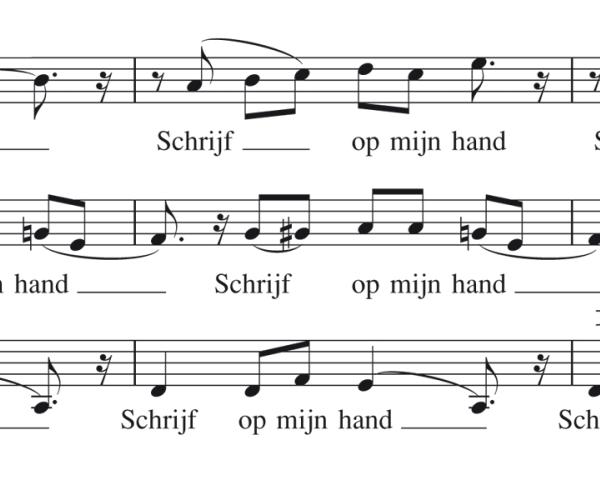
With Tegen het zwijgen,Hans Helsen (born 1989) completely contradicts the expression ‘Speech is silver, silence is golden’. The text of Jos Stroobants conveys new truths: ‘Schrijf ...dat kilte ons slechts haalt en ons vermaalt tot niets wanneer we zwijgen.’ (Write ... so that the cold only gets us and grinds us to nothing when we are silent). As such, Helsen gets his female choir to sing almost continuously, with the exception of a few accurately placed resting moments. An evolving recurring motif through the various voices gives structure and credibility to composition and text content. Beautiful and interesting composition for women's choir.
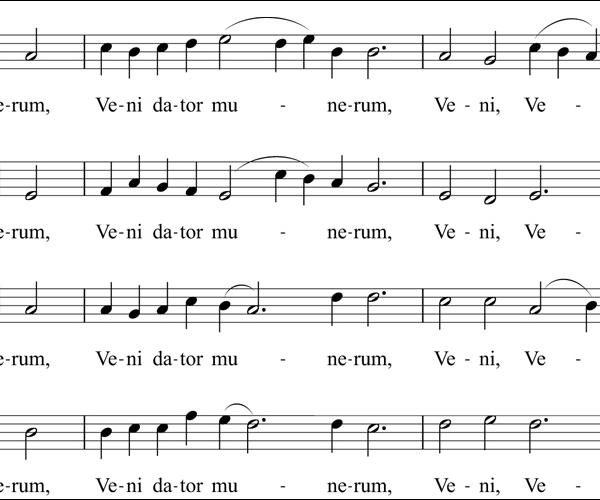
In Veni Sancte Spiritus Frank Agsteribbe combines pure Gregorian chant with simple homophonic settings into a tasteful whole.
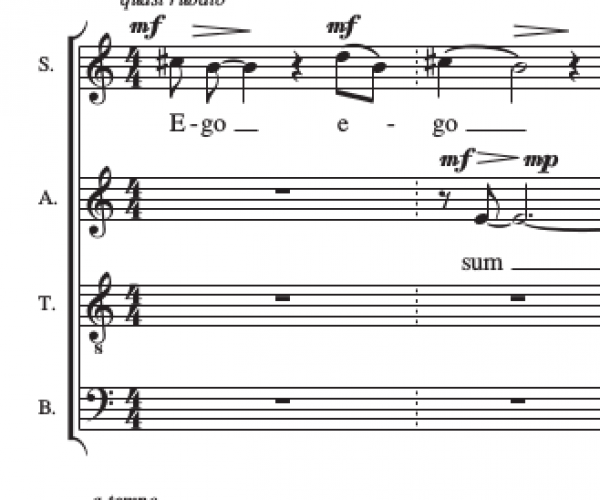
Ego sum vitis vera (I am the true vine) is a communion song. The beautiful text inspired the composer to create a composition with a drive and a storyline through a play between male and female choir, surrounded by flowing and natural lines and uplifting sound auras. Rhythmically, this is not an easy piece, but once the score is mastered, the fruits are all the sweeter.
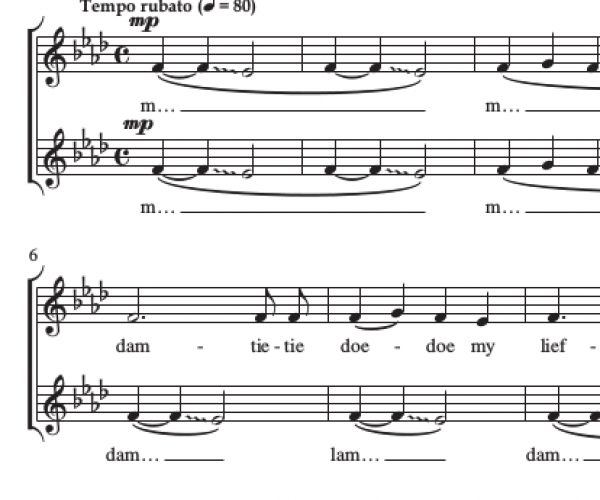
Maarten Van Ingelgem (°1976) took his inspiration from the African Lamtietie Damtietie. The author of the text, Cornelis Jacob Langenhoven (1873-1932), is regarded as one of Africa’s best-known writers and, as a member of parliament, campaigned tirelessly for Afrikaans to be an official language in South Africa. The poetic text was expressed in an evocative contemporary lullaby for a children's, youth or women's choir that is not intimidated by chants and whistles. Dedicated to Ida & Ellis, daughters of Van Ingelgem.
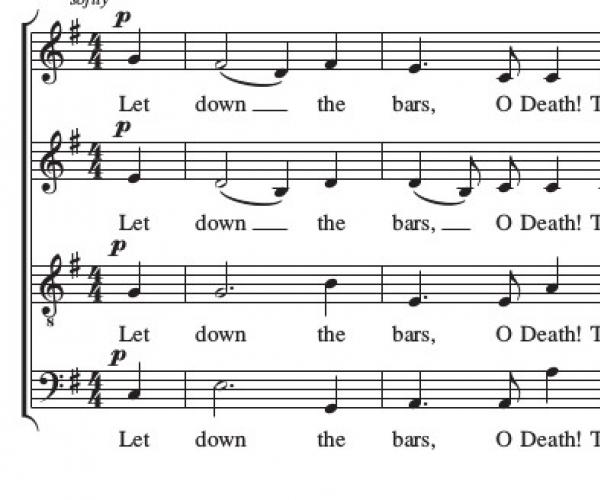
Let down the bars, O Death! is a sensitive composition. The work reflects the sad atmosphere of the text by Emily Dickinson (1830 - 1886). It is a short, expressive and rather easy work that will appeal to many mixed choirs. In the compilation Songs and Song Cycles for mixed Choir a cappella on English and American poetry, published by Musikproduktion Höflich in Munich in 2013 you will find many other beautiful work by Coryn.
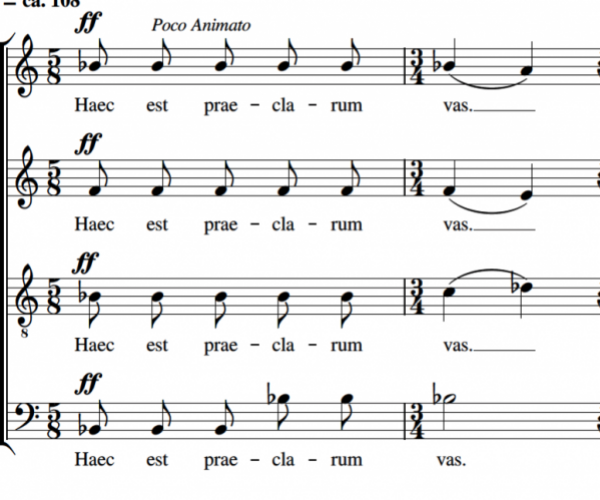
An accessible four-part motet written for the European Music Festival of Youth, Neerpelt in 1977.
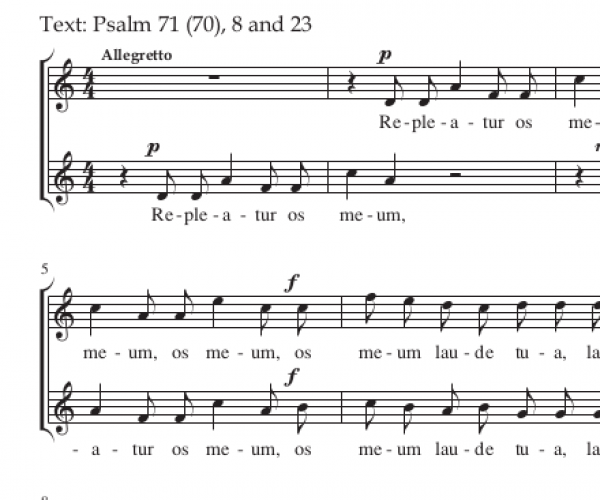
Repleatur os meum is a fresh choral work on psalm texts for two equal voices. It was written in 1969 and used in 1970 for the European Music Festival for Young People in Pelt (EMJ) in the Wimpel series. Repleatur os meum is a choir song that can be enjoyed by both the choir and the public.
Pages
- « first
- ‹ previous
- 1
- 2
- 3
- 4